Levers


A lever is a simple machine that makes work easier for use; it involves moving a load around a pivot using a force. In a level there are a load, a pivot and an Effort (force).

Lever are amongst the oldest form of mechanical system. The input of this system is called the effort and the output is called the load. In the image, we have the input as F1 and the output as F2. The bar  pivots on a fixed point (fulcrum). 

.

 The principle of the lever tells us that the levels is in static equilibrium, with all forces balancing, if F1D1 = F2D2.

In order to lift a bigger load (L1) the distance to the fulcrum has to increase (D2) or make the distance D1 smaller. 

Exercises:

1º You need to lift a load of 200 kg. The distance from the load to the pivot is 6 meters and the distance from the pivot to

where the force is applied is 20 meter. Calculate the value of F1.
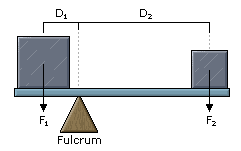
                                                                                                                                                                                                                                                                                    

2º On the lever showed in the image D1 = 20,   D2 = 400  and F1 = 300 Kg. Calculate the value of F2

3º On the same image, calculate the value of D1 if D2 = 70m, F1 = 300Kg and F2 = 60kg